


‘Every Day Above 1.5 C is Now Going to Matter’

HONG KONG – In Nepal, a catastrophic Himalayan slope collapse in August triggered floods that killed more than 1,300 people. 2026 brought the warmest summer on record in the United States. In Hong Kong, hourly rainfall records that were once broken only every few decades have been exceeded several times in recent decades.
As extreme weather becomes more frequent and intense, policymakers face difficult choices over solutions to limit the damage. The 2015 Paris Agreement calls on countries to hold the rise in global average temperature to well below 2 C above pre-industrial levels, while pursuing efforts to limit it to 1.5 C. But what happens if the temperatures rise beyond these limits?
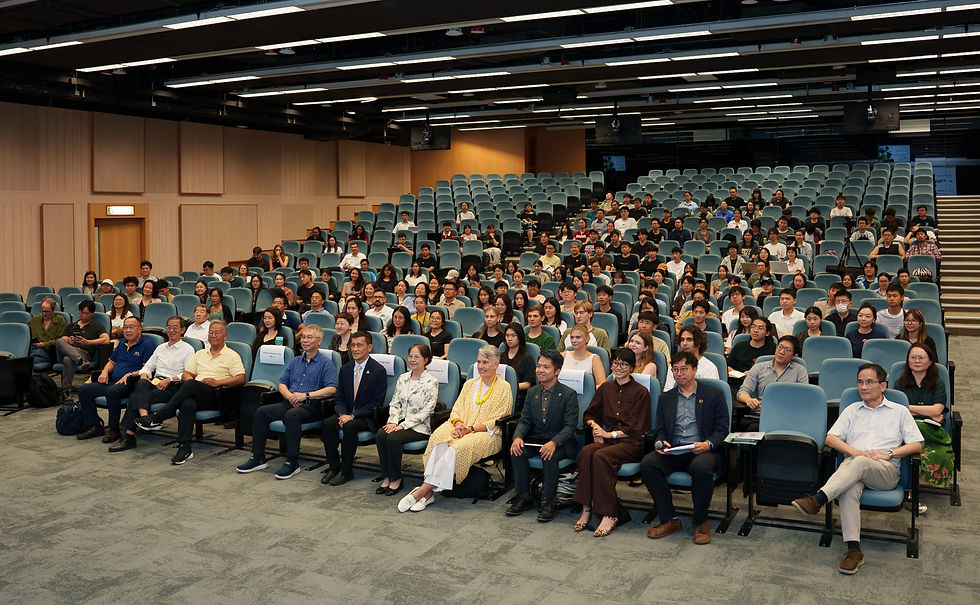
In early September, the United Nations Environment Programme (UNEP) released a report, “Limiting Overshoot - Navigating exceedance of 1.5 C and pathways towards return” to present an overview of the reality if global temperatures exceed 1.5 C. Later in the month, Debra Roberts, one of the report’s lead coordinators and authors, presented its latest findings at the Chinese University of Hong Kong.
“While exceeding 1.5 [C] now is unavoidable, how high we go and for how long it lasts is very much still … in our hands. Every day above 1.5 [C] is now going to matter,” said Debra.
The Uncertainty of Carbon Removal
An environmental scientist with 40 years of experience in climate policy and biodiversity planning, Debra Roberts has co-authored reports for the Intergovernmental Panel on Climate Change (IPCC). During her time with the government of Durban, a port city in South Africa, she was responsible for environmental planning and strengthening the city’s climate resilience.
Debra predicted that global warming levels will exceed 1.5 C within three to four years. This would mean increased extreme weather events, glacial melt, sea-level rise, and ecological damage. The report estimates that global food production could decline by 14% by 2050. By the end of this century, glaciers could lose more than a quarter of their mass, adding up to 12.5 cm to sea levels if warming reaches 3 C.
“We’ll enter into a world of which we have no experience. We’ve never lived in a world that warm.”
This does not mean action is useless. On the contrary, Debra said that we need to act immediately to cut emissions and slow the rise in temperatures.
The report proposes an “exceed, decline, stabilise” approach: after temperatures cross 1.5 C, they could be brought down through methods such as carbon dioxide removal.
The smaller the exceedance, the greater the chance of temperatures falling back to the 1.5 C level, Debra pointed out. The report’s most optimistic projection puts the peak temperature rise at 1.8 C if countries meet their current emissions-reduction commitments. Beyond 1.8 C, returning to 1.5 C would become increasingly difficult.
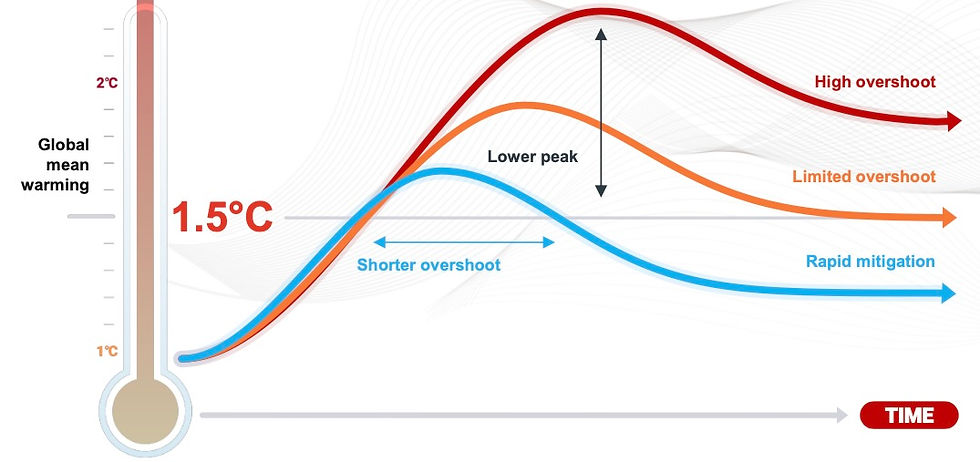
But here is a catch: the feasibility of carbon dioxide removal is still uncertain. The report indicates that current afforestation and forest-management methods would take 100 years to reduce warming by 0.1 C, assuming zero residual CO₂ emissions, while other novel technologies (such as bioenergy combined with carbon capture and storage, direct air carbon capture and storage, biochar, and enhanced rock weathering) only achieve one-thousandth of the effect currently. Even under the most favourable scenario, carbon dioxide removal methods would take 50 years to reduce warming by 0.25 C.
Some impacts are irreversible or could take decades to reverse. Even if global warming is stabilised at current levels, global glacial loss is projected to continue for centuries. Exceeding 1.5 C and later returning below it will lead to additional glacial loss, but less than stabilising at a higher level.
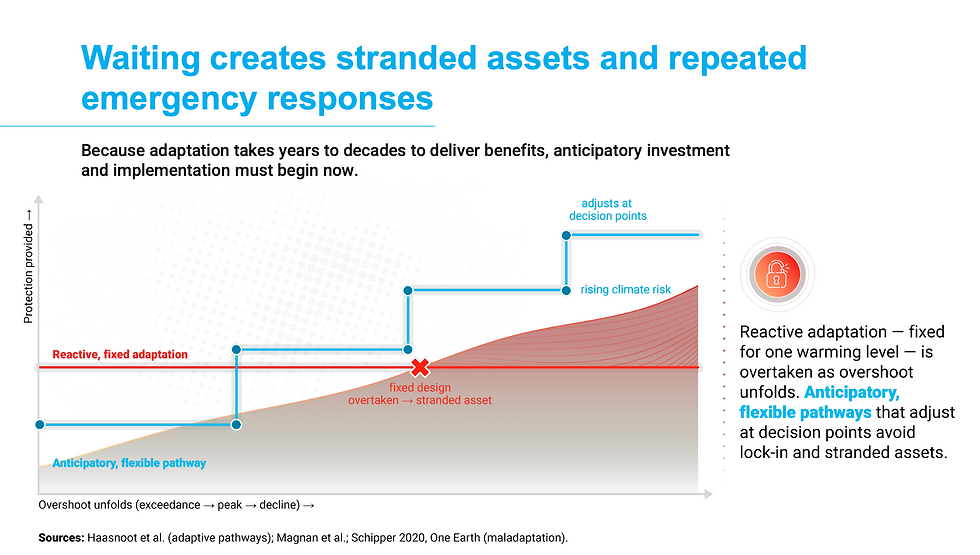
“1.5 C is actually not a safe level; it’s just less dangerous than temperatures that are higher,” Debra said. She added that countries need to develop flexible climate adaptation policies because we may live with excessive warming for decades or even millennia.
So, should adaptation start before the worst impacts arrive? Debra says yes.
Decision-makers need to examine whether existing infrastructure can withstand a warmer world. For example, by 2050, 76% of urban tree species will be at risk.
During the 2010 World Cup in Durban, South Africa, trees were planted on 580 hectares of land — an area roughly equivalent to around 700 football fields — to offset carbon emissions and enhance urban resilience. Policymakers need to identify which tree species will survive, and replace those that cannot.
Many existing policy decisions may need to be adapted to new conditions. Coastal cities (such as Durban and Hong Kong) may need to consider not only infrastructure development to protect the coastline, but also strategies to relocate from the coast, Debra said.
The Xylom previously exclusively reported how the 2022 IPCC Sixth Assessment Report criticized the highly unpopular Mumbai Coastal Road, which has nearly halved incomes and daily catch of lower-caste fishermen, as an example of “maladaptive” infrastructural intervention.
“The Mumbai Coastal Road (MCR) project aimed at reducing flood risk and protecting against [sea-level rise] will potentially cause damages to intertidal fauna and flora and local fishing livelihoods,” the authors wrote.
Jakarta’s Great Garuda sea wall project is another example of maladaptive infrastructure. While the project’s sea wall and 17 artificial islands are meant to protect the city from sea-level rise and create a huge new urban quarter, there is a strong possibility that the project will exacerbate flooding, especially for poor households.
Debra emphasised that adaptation policies should be forward-looking and flexible, rather than reactive to disasters. Such an approach can protect assets, reduce the need for emergency response and free up resources for emissions reduction and long-term planning.
The Role of Nuclear Energy
The UNEP report calls for an accelerated energy transition, with renewable energy reaching 60% to 70% of global electricity generation by 2030.
Can nuclear energy, a low-carbon but controversial energy source, help bridge the gap?
“Nuclear has to be part of the mix. We don’t get to limit temperatures or reduce emissions unless nuclear is part of the mix,” Debra said. She noted that the UNEP report draws on the IPCC’s Sixth Assessment Report, whose modelled pathways all include nuclear power in the energy mix. As pressure to reduce emissions grows, she said, the share of nuclear power is likely to increase.
The IPCC’s Sixth Assessment Report describes nuclear power as an established energy source that can be deployed at scale. In pathways limiting warming to 1.5 C, nuclear energy use would need to increase by 40% between 2019 and 2030. Other less ambitious pathways would also see increases of 10% to 35%.
In fact, data on deaths and emissions per unit of electricity generated show that nuclear power is among the safest and lowest-emission sources of electricity.
Nuclear energy may not be equally accessible to all countries. Some regions in Africa may lack the experience and technology needed to manage it, Debra said. However, she emphasised that nuclear energy remains essential, pointing to France, where nuclear power supplies much of the country’s electricity.
“Renewables, obviously, are always envisaged to be the greater part. But you don’t actually get over the line unless you use absolutely every technology you have at your fingertips,” Debra said.
Can We Be Hopeful?
At the Chinese University of Hong Kong event, an attendee asked Debra if she thought there was still hope. “For me, hope is not a strategy. It doesn’t get anything done. I’m a realist. But I do believe that science and research are such important tools that can give us a sense of where we might be able to act,” she said.
“So, I’m not hopeful; I’m a firm believer in hard work, and I believe by encouraging people to see that there is real purpose in doing that work, we can create the kind of momentum in society that will create change.”
Limiting warming to 1.5 C seems difficult, but before the 2015 Paris Agreement, global warming was projected to reach a 4C rise by 2100, while the current projection is 2.6 C, Debra pointed out. She said this is “still not good enough,” but shows that science, policy, and grassroots action can bend the curve.
A firm believer in translating scientific research and international frameworks into local action, Debra encouraged people to ask questions and pressure policymakers to take bold climate action.
“Now is really the time. We’ve got a very limited opportunity to try and reduce the level of temperature increase that we will experience. I think every one of us has a role now to deal with this challenge.”
The call for action comes as Hong Kong prepares to review its own climate policies. The Hong Kong Climate Action Plan 2050 is due to be updated, setting the course for the city to halve its carbon emissions from 2005 levels before 2035 and achieve carbon neutrality before 2050. The city’s emissions have already fallen by 27% from their 2014 peak, but electricity generation still accounts for 61% of total emissions, followed by transport at 18% and waste at 8%.
Renewable energy only accounted for 1% of Hong Kong’s electricity mix as of 2023, with the city’s rooftop solar incentive scheme garnering mixed results.


