


In Cambodia, the State Claims Forests. But People Push Back
This story is produced by The Xylom and co-published by Mekong Independent.
Clad in white — a symbol of mourning — outside the Phnom Penh Municipal Court in July 2024, Ly Chandaravuth spoke into a microphone, urging fellow activists to hold the line on peace.
A key member of Mother Nature Cambodia, an organization that works with frontline activists to protect the country’s environment, Chandaravuth was awaiting a verdict in a case in which he and others were charged with “plotting against the state”, with some also accused of “insulting the king.”
Around 50 police officers descended on the group, dragging them into vehicles. Chandaravuth and four colleagues were arrested and dispersed to prisons across the country, while five others were sentenced in absentia — all handed prison terms ranging from six to eight years. They were transferred far from their homes and families, which, according to Human Rights Watch, “limits family visits, medical care, and access to legal assistance.”
This was not the first time Mother Nature Cambodia’s members got arrested. “This is their [government’s] way of traumatising us,” Lisa Mean told The Xylom.
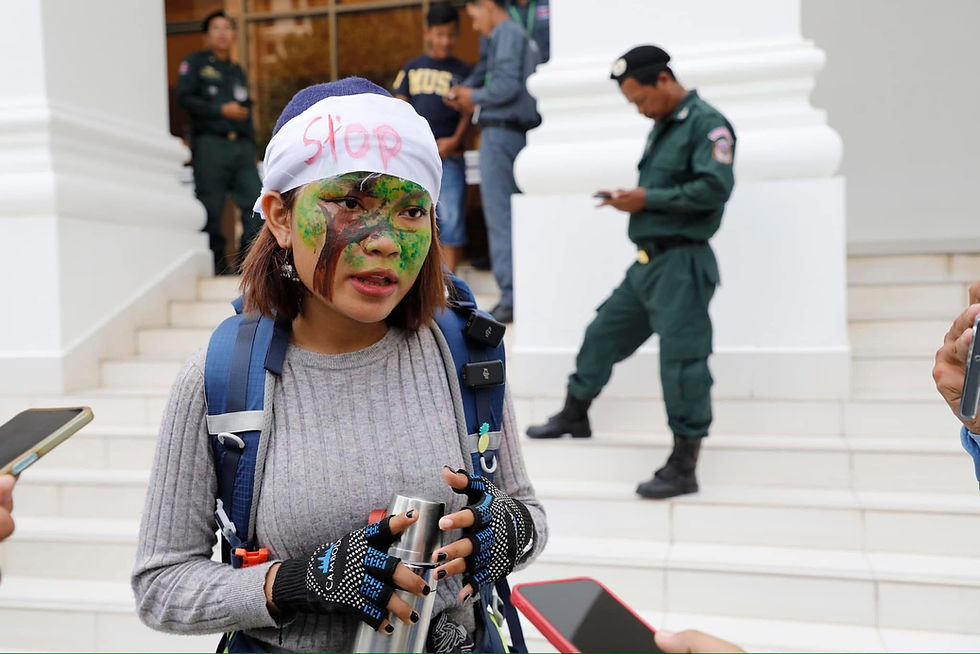
A former law student, 23-year-old Mean joined Mother Nature Cambodia three years ago to pursue equality and justice. She was drawn to the group’s commitment to nonviolent action, even under the constant threat of imprisonment.
A coalition of 53 organizations issued a joint statement on July 4th, 2024. “This reliance on trumped-up charges to malign Mother Nature’s activities as attacks against the state reflects a failure to understand that jailing environmental and youth advocates only harms the country’s future. We should be honouring these activists, not imprisoning them,” the statement said.
Let’s Dig Deep Together.
Subscribe to The Xylom's free weekly newsletter to get more updates on our collaborative investigations into global health and environmental disparities
The State of Affairs
Among its campaigns, Mother Nature Cambodia is known for helping cancel land privatization in Kirirom National Park, opposing deforestation in Kampot’s Bokor Mountain, and calling for curbing plastic pollution in the Sangkae River.
Police harassment comes amid rapid environmental decline and an authoritarian political climate. Between 2001 and 2021, Cambodia lost nearly a third of its forest cover, with deforestation closely tied to the expansion of Economic Land Concessions (ELCs), where large tracts of land, including protected areas, were leased to private companies for agri-industrial use.
Cambodia has been governed for decades by the Cambodian People’s Party under Prime Minister Hun Sen, who held power from 1985 to 2023, with political power concentrated within his family. In August 2023, his son, Hun Manet, took office. While some observers initially hoped the younger, Western-educated leader might bring change, reports say that the human rights situation has continued to deteriorate.
Although the then-Prime Minister Hun Sen announced a moratorium on ELCs in 2012, land clearances persist. A 2022 study in Nature found forest loss was higher between 2011 and 2021, with 1.7 million hectares cleared, compared to 885,000 hectares between 2001 and 2010.
The Cambodian League for the Promotion and Defense of Human Rights (LICADHO) says the government has yet to fully disclose details of previously granted concessions, many of which remain active. A significant share is held by companies with close ties to the ruling Cambodian People’s Party, including LYP Group, owned by Senator Ly Yong Phat. Other concession holders include firms from Vietnam, China, Malaysia, and Singapore.
ADVERTISEMENT
The Xylom contacted Cambodia’s Ministry of Environment and the Ministry of Agriculture, Forestry, and Fisheries for comment, but received no response. “We must accept the fact that development inevitably has some impact,” a government spokesperson was quoted in the documentary movie produced by Mongabay, The Clearing.
Local activists challenge that narrative. “Deforestation has contributed very little [to development]. It is not a fair and just contribution. It is just a contribution to some bad officials who make money from forestry,” says Ma Chettra, an environmental and human rights activist who works with organizations and communities by patrolling the forests and participating in protests.
Chettra calls the arrests of environmental activists “a barbaric thing.”
“Last year, after I patrolled the forest, the provincial Department of Environment issued a warning letter to me. They threatened to take action … saying that I was patrolling the forest illegally,” Chettra says.
According to Chettra, the only positive step is the crackdown on illegal logging, with authorities asking communities to report offenders. “If the government really wants to protect forests, it must strengthen the law. The Ministry of Environment must have a special investigation team … to look into cases of deforestation and corruption.”
A Leading Voice
Mother Nature Cambodia stepped in to hold the government to account, demand justice, and safeguard the country’s natural resources. In 2015, the government dropped plans to build a hydroelectric dam in the Areng Valley after the group mobilized local residents and staged peaceful protests.

In 2017, the group halted sand mining in Koh Kong province, a key area of operations for LYP Group. “Our colleagues lived with people in a floating village [in Koh Kong] to strengthen their understanding of how sand mining affects their lives and livelihoods — and what they can do. They organized protests on boats. It was very inspiring to hear their speeches,” Mean says.
The group empowers local communities and youth to speak out. “We often bring young people to the field for a better understanding … which helps them connect environmental issues with real human consequences,” she adds.

Unfortunately, many of these victories are short-lived, with sand mining and exports persisting across Cambodia.
Yet, they have not stopped taking on new goals. Take the mangrove-dense Koh Kong Island, which the Cambodian government promised to declare a marine national park in 2021, but has since left vulnerable to unsustainable development.
“We are protecting the island from the tycoons [who want] to carry out development. The practice of development in Cambodia is not for everyone. It has always been for luxury resorts, luxury restaurants, and golf courses,” Mean says.
Another campaign targets illegal, unreported, and unregulated fishing (IUUF) by foreign vessels, which has reduced local catches by as much as 60% between 2017 and 2022, according to the Asian Development Bank’s report. With satellite and radar data, Mother Nature Cambodia tracked fishing boats entering Cambodian waters and converted the findings into viral, impactful videos.
‘Information Finds a Way Out’
The government’s unabated environmental destruction has drawn both national and international attention.
However, the government left no room for dissent. Local environmental journalist Ouk Mao, who reported on illegal logging in a protected area for Eagle News, was arrested and charged last year.
Mongabay’s Southeast Asia staff writer Gerald Flynn has reported on sensitive investigations, including illegal fishing and its impact on local communities, and logging linked to a senior government official. He was denied re-entry to Cambodia in early 2025. “Being told that I am permanently banned from entering Cambodia was definitely a setback,” Flynn told The Xylom.
ADVERTISEMENT
But that doesn’t stop journalists from reporting these issues. “But you can't stop the Signal [private messaging platform]. Information always finds a way out, even from the most repressive spaces,” Flynn says.
In fact, the restricted political environment has fostered collaboration between journalists and led activists to adopt social media to sensitise people. “So in that sense, being banned hasn’t changed much,” Flynn says. He continues to work with a network of freelancers on the ground, providing desk-based support for Cambodia stories.
Mother Nature Cambodia uses cartoons, reels, and documentary-style footage to spark public conversations about environmental issues and make them easier to understand for a wider audience, especially youth. “As young people live more in the digital world, they have access to a better understanding, and that pushes for change,” says Mean.

On March 2nd, 2026, Cambodia’s Supreme Court declined the release of imprisoned activists. However, the movement has found ways to be heard. Team Mother Nature Cambodia is running a crowdfunding campaign to raise money to support the legal aid and other basic needs for their colleagues in prison. “Please keep an eye on our country, whenever you can,” Mean appeals to the international community. “Nature is for everyone across the globe. … Staying united together, we can protect [it] for the next generation.”


