


The Xylom's ‘All Hell Breaks Loose’ Reporting Wins Online Journalism Award

The Online News Association has named The Xylom and partner newsrooms a winner of an Online Journalism Award, which honors excellence in digital journalism around the world.
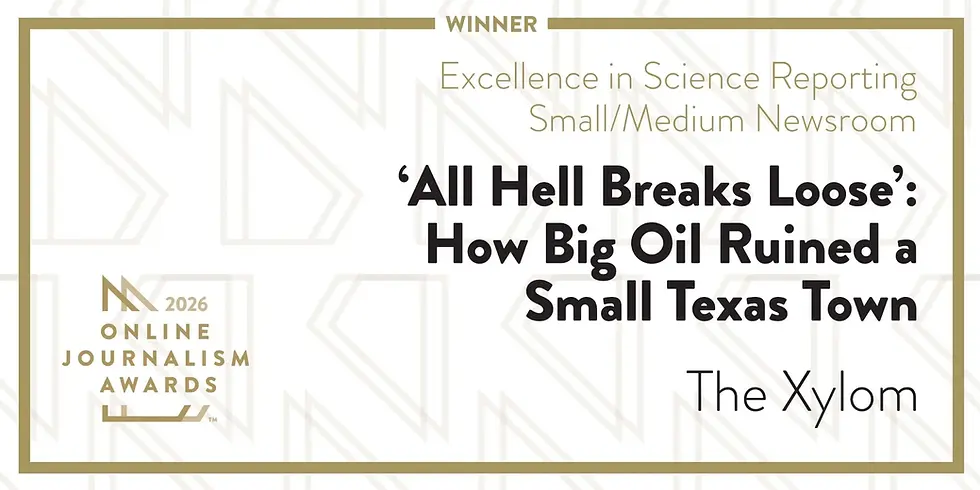
‘All Hell Breaks Loose’: How Big Oil Ruined a Small Texas Town, a three-part series published in collaboration with Floodlight, Drilled, and Deceleration, won the Excellence in Science Reporting (Small/Medium Newsroom) category.
The judges wrote:
We hope that our selection of a micro-newsroom of two people is a testament that pure enthusiasm and professionalism can win over large budgets. It is a very strong science journalism piece with a clear public service dimension.
In addition, one of the judges, Andrei Savenkov, wrote in a public statement:
Micronewsrooms keep my faith in the future of journalism despite the year of extreme hardships and job cuts in the industry. […]
A story that touched my heart the most is the investigation that young reporter Alex Ip launched as a student into the impact of booming U.S. crude oil exports on a small town in Texas and the lack of monitoring for toxic chemical risks.
He applied his empathy and environmental engineering degree to the story that ultimately outshined even some of the most decorated and biggest newsrooms in the U.S.
The honor marks the first OJA win for The Xylom, which competed in a combined category against newsrooms with up to 250 employees; this series was also named a finalist in the 2026 Nonprofit News Awards in the Best Investigative Journalism category.
The most recent investigation emerged as President Donald Trump returned to the White House on a "Drill Baby Drill" agenda. Since 2018, the United States has exported more crude oil than any other country at any point in history, despite a four-decade-old federal ban on the practice repealed only in December 2015.
Publisher and Editor Alex Ip spent three years reviewing contemporaneous social media posts and media clippings, analyzing publicly available federal databases, statements by public officials and reports by crude oil export facility owners; completing spatial analyses; attending public meetings; and interviewing residents, educators, advocates, Native American leaders, current and former regulatory experts, crude oil export sector representatives, and elected officials. An abridged version of this series became his thesis at the MIT Graduate Program in Science Writing.
Alex anchored the reporting in the experiences of residents along the Texas Coastal Bend who have been directly impacted by the crude oil export industry. He traveled thousands of miles to talk to residents, advocates, and leaders of the small town of Ingleside on the Bay, population 614. The South Texas town, located in San Patricio County, saw its toxic chemical risk increase nearly 17-fold between 2018 and 2022, despite being over 85% non-Hispanic white, voting for Donald Trump by over 50 points three times, and having the second-highest home prices in the region.
Alex found that these three large crude oil export facilities built on a decommissioned naval base immediately outside Ingleside on the Bay's boundaries were responsible for nearly half of all U.S. crude oil exports in 2024 – 700 million barrels worth roughly $50 billion:
Ingleside Energy Center, the largest crude oil export facility in the United States at the time of reporting, owned by the Canadian energy giant Enbridge
South Texas Gateway, the second-largest crude oil export facility in the United States at the time of reporting, owned by the Canadian energy giant Gibson
Ingleside Marine Terminal, which saw two oil spills during the reporting period, owned by the Koch Industries subsidiary Flint Hills before being purchased by Enbridge in 2024.
They were built because power brokers representing Corpus Christi on the regional port commission ignored the views of San Patricio County and executed three separate land sales totaling more than $100 million in 2012, anticipating the conversion of the decommissioned naval base into future crude oil export facilities, despite the practice being illegal at the time.
Despite known risks and resident complaints of asthma and cancer cases, San Patricio County does not have a working ambient air monitor that meets federal reporting requirements. Local elected officials were never told about the toxic chemical risk; only two fire trucks serve Ingleside on the Bay, manned by volunteers who lack access to personal protective equipment.
After the EPA recorded 15 months of “High-Priority” Clean Air Act violations, the TCEQ only fined Ingleside Marine Terminal $21,800, or less than the profit the company makes every two minutes. A year later, the Commission agreed to a five-year renewal of its Federal Operating Permit. As the only reporter from any newsroom at a January 2024 Texas Commission on Environmental Quality Notice and Comment Hearing in Portland, Texas, on Ingleside Energy Center's federal permit renewal, Alex also recorded a TCEQ official admitting to residents that the agency has never rejected a federal operating permit application for similar facilities.
This is the first time any reporter has been able to pinpoint a nexus in the U.S. crude oil export industry and attempt to fully quantify its devastating environmental health impacts on humans and wildlife. Following Alex's reporting, the TCEQ confirmed that it will install its first ambient air monitor in San Patricio County at Portland by the end of 2026. To this day, a bipartisan, multiracial coalition of residents along the Texas Coastal Bend continues to mobilize against oil and gas development in the region, particularly after Corpus Christi came dangerously close to being the first major American city to run out of water in Summer 2026.
The ‘All Hell Breaks Loose’: How Big Oil Ruined a Small Texas Town includes the following pieces:
Congratulations to the team for the recognition of their hard work: Alex Ip (investigative reporting, photography, and visuals); Lai Wa Chu and Jaime Diaz, formerly at MIT (research); Amy Westervelt, Drilled (companion podcast); Rhysea Agrawal (copy editing and fact-checking); and Dee J. Hall, formerly of Floodlight (partnerships coordination).
Reporting of this story was supported by the Society of Environmental Journalists, Institute for Journalism and Natural Resources, and the Kelly-Douglas Fund at the MIT School of Humanities, Arts, and Social Sciences.
Congratulations, too, to all of this year’s ONA award winners.


